More than two decades separate the early development of Lestari Putra from the neighbourhood that exists today.
Behind that passage of time is the quieter story of township development: houses becoming homes, streets becoming communities and new businesses and services emerging around an established population.
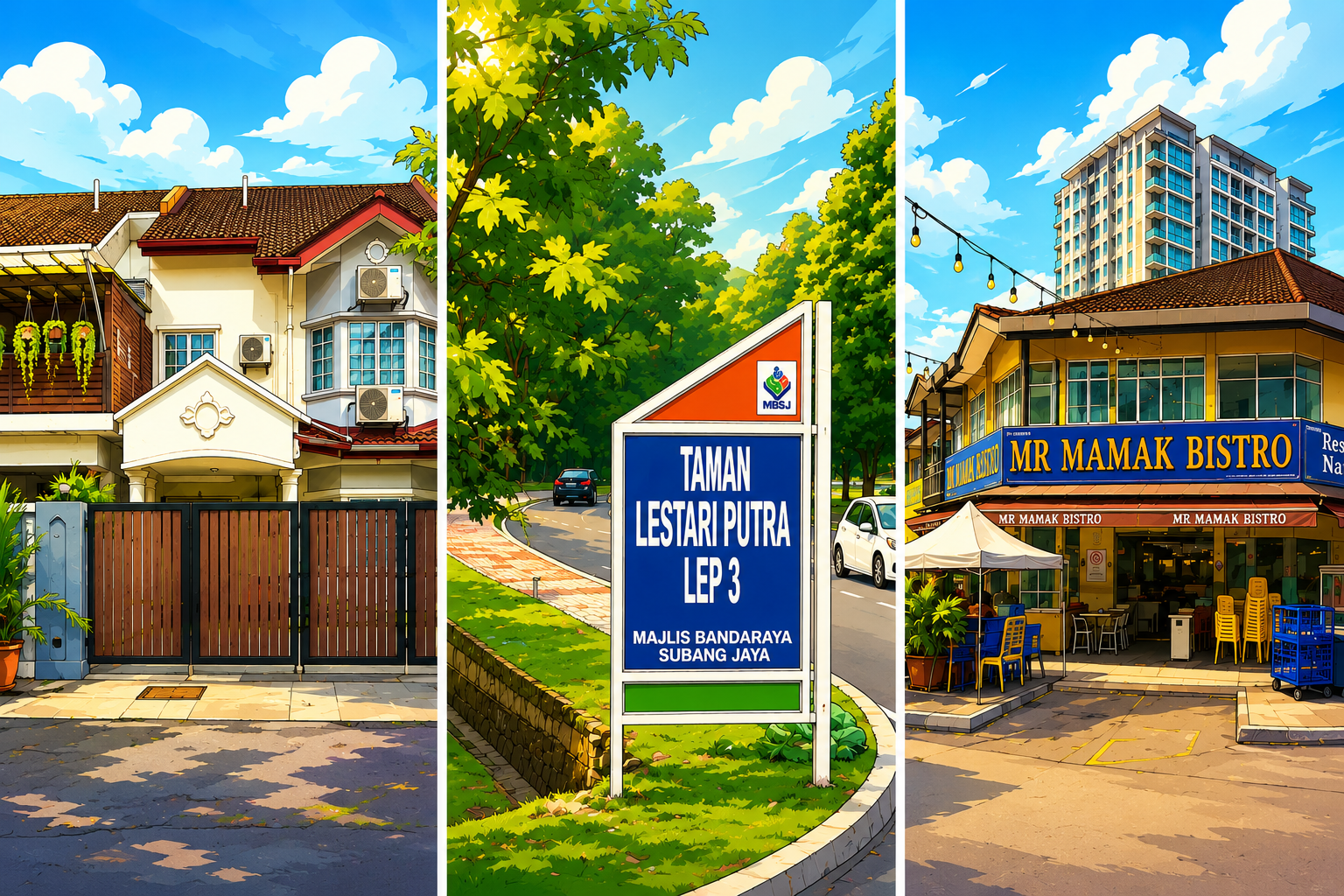
The residential character of Lestari Putra was built predominantly around landed homes.
Among its residential components were Amaryllis, comprising approximately 275 units and predominantly 18′ × 65′ homes, and Artemisia, with approximately 152 units, predominantly in the larger 20′ × 70′ configuration.
These formed part of a broader development containing mainly double-storey terrace houses together with commercial properties.
What was originally developed as Lestari Puchong, before subsequently becoming known as Lestari Putra, today forms part of the wider Bandar Putra Permai–Seri Kembangan residential landscape.
And the landscape surrounding it has changed considerably.
Retail and commercial centres have expanded across Seri Kembangan and neighbouring areas. Major destinations including The Mines and IOI City Mall are now part of the wider catchment.
Education has similarly become an important feature of the surrounding corridor, with institutions including Universiti Putra Malaysia, together with schools and other educational facilities serving the broader population.
Healthcare, retail, restaurants, banks and daily-needs businesses have further strengthened the surrounding ecosystem.
Within Lestari Putra itself, the neighbourhood businesses highlighted earlier in this series — convenience stores, restaurants, cafés, clinics, pharmacy and everyday services — demonstrate another characteristic of an established township: daily life increasingly takes place within the community itself.
The property comparisons in Part One provided another perspective on that passage of time.
Homes originally recorded at developer selling prices beginning from below RM140,000 during the 2001–2005 period now sit within a very different property market.
But those numbers tell only part of the story.
The longer legacy of a residential development is ultimately found in whether it continues to function as a place where people live, businesses operate and communities remain.
Lestari Putra has moved through those stages.
From Lestari Puchong, to the building of its homes and commercial properties, to its present position within a mature and increasingly connected part of Selangor, its development reflects how a township can continue evolving long after construction ends.
This concludes our three-part Lestari Putra series — a look back at where it began, how its location evolved and the established neighbourhood it has become today.
LESTARI PUTRA: BUILT THEN, ESTABLISHED TODAY