A township may begin with land and homes, but its ability to grow depends heavily on how well it connects to everything around it.
For Saujana Puchong, connectivity became an important part of that story.
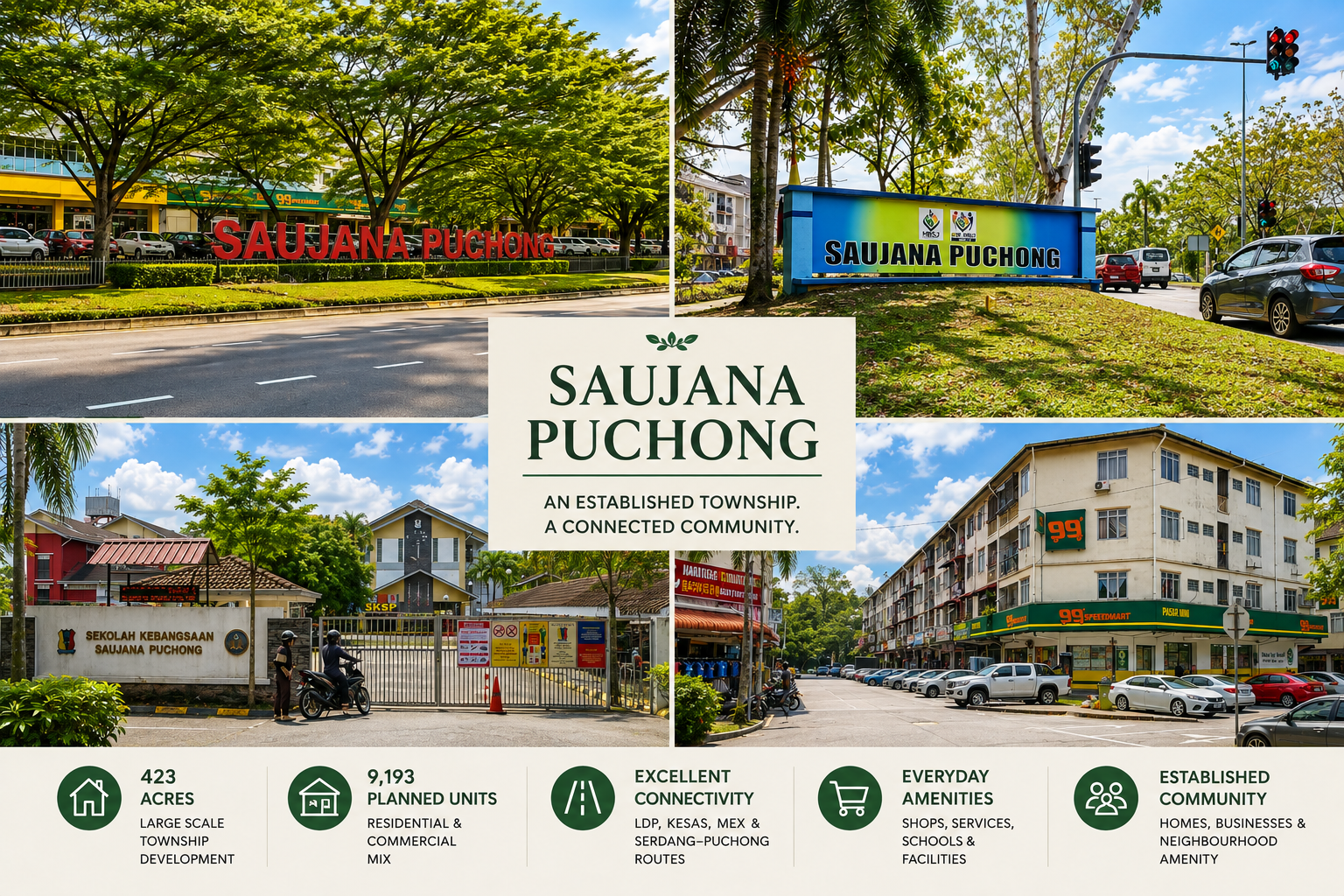
Located in Puchong, Selangor, the approximately 423-acre township sits within reach of established Puchong while connecting towards the wider Serdang, Putrajaya and Cyberjaya corridor.
Its location provides access through major road networks including the Lebuhraya Damansara-Puchong (LDP), KESAS, MEX and the Puchong–Sungai Besi Highway, together with Serdang–Puchong connections.
These routes extend Saujana Puchong’s reach beyond the immediate neighbourhood, providing connections towards Bandar Puteri Puchong, IOI Mall, Puchong town centre, Cyberjaya, Putrajaya and Kuala Lumpur International Airport (KLIA).
For a township planned with 9,193 residential and commercial units, those connections matter.
They allow a large residential community to function as part of a much wider urban network rather than in isolation. Residents have access beyond the township for work, education, shopping and other daily needs, while the township itself has continued to develop its own supporting commercial activity.
From Residential Development to Connected Community
In Part 1 of this series, we looked at the scale on which Saujana Puchong was originally developed and how the average market prices provided today compare with average developer selling prices from 1999 to 2002.
But property values tell only one part of the township’s evolution.
As Saujana Puchong matured, its position within the wider Puchong area became increasingly relevant. What began as a large-scale mixed residential and commercial development became part of an established network of communities across Puchong and the surrounding growth corridor.
That connectivity supports the township’s residential character while also strengthening the role of its commercial component.
Saujana Puchong was planned with a mix of terrace houses, apartments and commercial properties, creating its own population catchment. As that population established itself, neighbourhood businesses and services had a community to serve.
Today, that can be seen in the commercial activity operating within Saujana Puchong itself.
A Township That Works From Within
The presence of everyday businesses and services including 99 Speedmart, LaundryBar, KK Mart, Mixue, Pasaraya Karnival, restaurants, a car workshop and Klinik Wawasan reflects a township with an established base of everyday activity.
Sekolah Kebangsaan Saujana Puchong further forms part of the neighbourhood infrastructure serving the community.
This is where connectivity takes on two meanings.
There is the external connectivity provided by the roads and highways linking Saujana Puchong with Puchong and the surrounding areas.
Then there is the connectivity within the township itself: homes, shops, services and community facilities existing alongside one another.
More than two decades after its development began, Saujana Puchong is no longer simply connected to what surrounds it.
It has developed its own network within.
That is the next stage in the story of a township built at scale: from development, to connectivity, to an established community.
Next in the series: Saujana Puchong — From Development to Established Community.
PART 2: SAUJANA PUCHONG — CONNECTED TO WHAT CAME NEXT